Engels's Dialectics of Nature and Marxist Ecology
Chen Yiwen
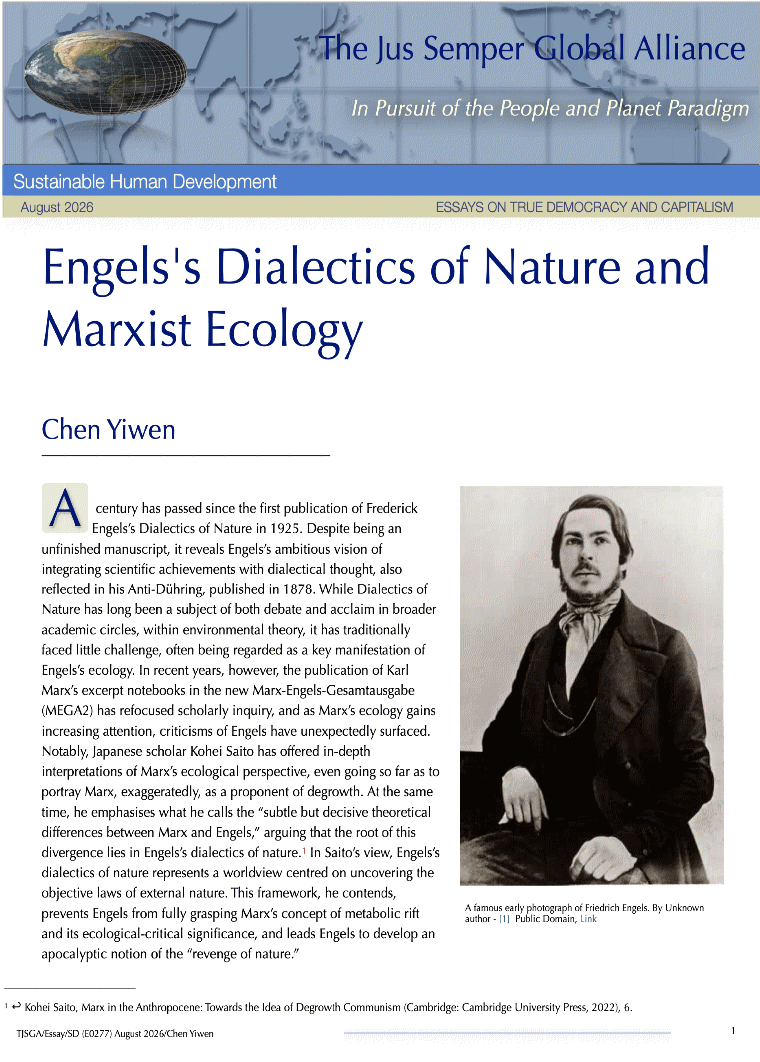
A century has passed since the first publication of Frederick Engels’s Dialectics of Nature in 1925. Despite being an unfinished manuscript, it reveals Engels’s ambitious vision of integrating scientific achievements with dialectical thought, also reflected in his Anti-Dühring, published in 1878. While Dialectics of Nature has long been a subject of both debate and acclaim in broader academic circles, within environmental theory, it has traditionally faced little challenge, often being regarded as a key manifestation of Engels’s ecology. In recent years, however, the publication of Karl Marx’s excerpt notebooks in the new Marx-Engels-Gesamtausgabe (MEGA2) has refocused scholarly inquiry, and as Marx’s ecology gains increasing attention, criticisms of Engels have unexpectedly surfaced. Notably, Japanese scholar Kohei Saito has offered in-depth interpretations of Marx’s ecological perspective, even going so far as to portray Marx, exaggeratedly, as a proponent of degrowth. At the same time, he emphasises what he calls the “subtle but decisive theoretical differences between Marx and Engels,” arguing that the root of this divergence lies in Engels’s dialectics of nature. In Saito’s view, Engels’s dialectics of nature represents a worldview centred on uncovering the objective laws of external nature. This framework, he contends, prevents Engels from fully grasping Marx’s concept of metabolic riftand its ecological-critical significance, and leads Engels to develop an apocalyptic notion of the “revenge of nature.”
For a full read of this commentary, click here or on the picture to download the pdf file. |