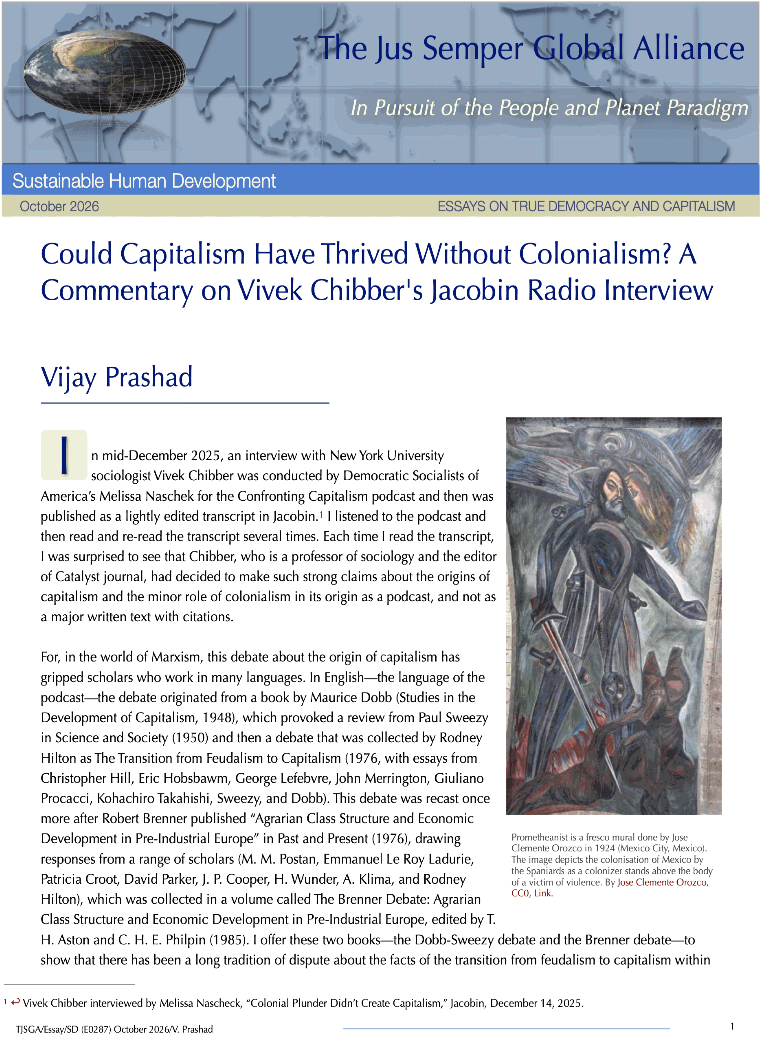
Vijay Prashad Early into the interview, Chibber says that he is going to dismiss the “idea that capitalism was brought about by plunder,” which he says, “had been pretty thoroughly discredited in the 1980s and ’90s.” The argument I am advancing here is not that colonialism mechanically “created” capitalism, but that capitalism emerged as a global social relation (through the creation of an international division of labour) with internal dynamics in Europe that were inseparable from colonial expropriation, coerced labour, and machine-mediated production elsewhere. Capitalism did not arise as a self-enclosed national system later projected outward. It emerged through global processes of dispossession, through the violent reorganisation of labour and nature across continents, and through the early deployment of machines in plantations, mines, and extractive complexes that disciplined labour long before the English factory became dominant. These were not peripheral episodes or mere “plunder,” but constitutive moments in the formation of capitalist social relations and the international division of labour. The wealth of the Global North was not merely accelerated by empire; it was constituted through processes of dispossession that destroyed alternative paths of development, reorganised social reproduction, and locked much of the Global South into relations of dependency that persist through debt, trade, and financial domination. To deny this is not simply to misread history, it is to disarm Marxism politically. A theory that severs capitalism from imperialism cannot account for the persistence of unequal development, racialised labour, and ongoing forms of primitive accumulation. A Marxism adequate to our world must therefore begin where capitalism itself began—not only in the English countryside, but in the plantation, the mine, the colony, and the machine. For a full review of this essay, click here or on the picture to download the pdf file.
|


- © The Jus Semper Global Alliance




| Home |  | Resources | | Economic Data | | Could Capitalism Have Thrived Without Colonialism? A Commentary on Vivek Chibber's Jacobin Radio Interview |

